
What is localization?
Why should you localize?
Need localization services?
The localization team
Localization tools
Localization process
Our clients
Don’t quite know what localization (L10N) is?
Localization is adapting software so it meets the requirements and customs of each target market. Well localized software will give the impression that it was developed in the native language and culture of its target market – specifically for the users in that region.
Why should you localize your material?
Because localizing now can save you a few headaches later – take a look at a real story that happened in China.
On March 20, 1998, a famous cosmetics manufacturer in China Beijing Sanlu Factory (now Beijing Dabao Cosmetics Co., Ltd) signed on one of the biggest IT companies in China at the time, Legend System Integration Co., Ltd (now Digital China) to implement the ERP software MOVEX from Intentia (now merged to Lawson Software). In the contract, Legend System Integration promised to deploy the ERP software for Sanlu within 6 months – if they missed the deadline, 5% of the contract sum would be paid to Sanlu as compensation – it seemed this should be a happy cooperationHowever, with the project progressing, Legend realized that MOVEX wasn’t completely localized into simplified Chinese and the accounting features didn’t meet the Chinese accounting requirements (it was still using the European accounting system designed for a Chinese client). Although Legend and Intentia went to Sanlu to try to solve these problems, they ultimately had to give up due to the limited resources they had such as time, money and personnel. – They were unable to provide a completely localized Chinese version of MOVEX as requested by Sanlu.Finally, after a 15-month trial, Sanlu Factory returned all the software and hardware of the ERP system (MOVEX) and received a 2 million Chinese Yuan compensation from Legend System Integration.
It’s clear that had MOVEX been completely localized into Chinese (including the accounting features, software itself and the documentation), and tested before it was being deployed to the client, the situation would have been different – the software would have been successfully implemented in China.
This had a great impact on how other companies in China view the ERP software and the importance of localization – In 1998, there were still only a few local companies in China trying to use the ERP software, all other companies interested in it were not confident in the new system, and they waited to see if there were any successful implementations. Had the cooperation between Legend and Sanlu been a success, Intentia would have made large amounts of money from the Chinese market last century.
As you can imagine, for a user who can’t read English, the possibility of using English software is very low – so a localized version will make all the difference.If you are a software provider, and you want to sell your product to a global market, you must have your product localized and tested in advance. But please note that for simultaneous ship software, pilot-language localization is suggested to be done before all other languages being localized – this will speed up the localizability of other languages and reduce your cost.
Need localization services?
You won’t be left out!
The project lead will communicate with both you, the localization team members, and any additional project managers during the entire process – so you won’t be left in the dark! Nobody knows more about the product than the creator, so we communicate with you to gain complete knowledge of your product for the best localization results.
After analyzing your project, we’ll develop a localization kit, set up a localization team, outline the localization process and tools to be used, and arrange a timeline for delivery, all specific to your project needs.The localization kit is based on the information you provided to us on your product. This is simply an ‘instruction kit’ that includes style guides for translation and desktop publishing (DTP), communication channels, a query management system, project timelines, file transferring rules – all the necessary information for the project to take off. The kit also allows us to keep track of any changes to instructions you may have along the way and incorporate them in a time sensitive manner. Is time an issue? – We’ll work with your schedule to meet the release date of your product. You approve the timeline before the project starts.
The localization team
The right process and a stable team are important factors to guarantee a successful, well localized product. Setting up the right localization team for your project is crucial.
The localization team usually includes a supporting role and some production teams:
- Technology support: from the software developing team (i.e. from your side), which can support other members in the localization team with their special knowledge on the product.
- Engineering team: prepares the files for the translation team and the DTP team, always handles tasks like pre-processing files and post-processing files, as well as compiling software or help files.
- Translation team: translators, editors/proofreaders – those who take on all related linguistic tasks.
- DTP team: multilingual typesetters, graphic artists, and specialists for compiling help files.
- Testing teams: both linguistic specialists from the translation team and engineers from the Engineering team familiar with the software.
Localization tools:
To guarantee quality, save you cost, and speed up the process, proper localization tools will be used at each phase of the project. Usually for localizing user interface (UI) strings, we select tools such as: SDLx or Trados from SDL, Déjà Vu from Atril, Catalyst from Alchemy, and Apple ResEdit from Apple. The following tools listed will most likely be used in your localization project:
- S-Tagger or Rainbow for file preparation
- A Glossary extracting tool like MultiTerm Extract will be used to create a glossary
- TagEditor, Workbench and MultiTerm will be used for translation of UI strings and documents
- Catalyst or SDLinsight will be used during translation of UI strings
- FrameMaker, Quark, Photoshop will be used for desktop publishing
- Catalyst or ToolProof will be used for software testing and QA
- Single-source multi-output tools like Robohelp or ePublisher will be used for help compiling or document creation
- HelpQA will be used in testing help files
- UltraEdit may be used to edit text and source codes of the software.
The tools selected in your localization project will depend on the type of source files you provide us with,and the platforms your products will be installed to. Effective and proper localization tools make your project go smoother.
Localization process
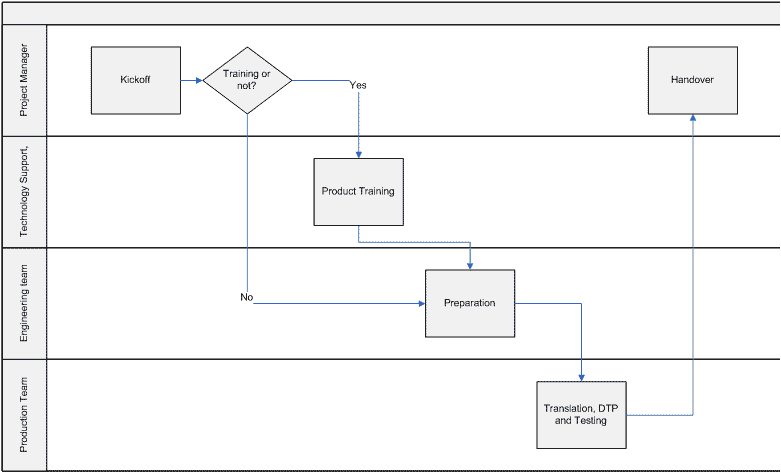
- Kickoff: We have an internal kickoff meeting with related members – always a good idea especially for a multilingual localization project. The main aim of the meeting is to make the instruction and responsibility explicit to each team.
- Product Training: If possible, at the beginning of the project, your technology support team can give our production teams (Engineering, Translation, DTP and Testing) training so we fully understand your product. This is particularly essential for a new product line.
- Preparation: We prepare your files to render them compatible with the localization tools. For example, some JavaScript files (.js) can’t be used by TagEditor directly, so we will use Rainbow to mark up the translatable text into a .rtf file format and then use TagEditor to translate them. Another example is for .fm files, we have to use S-Tagger to convert them to .rtf files before translating them in TagEditor (of course these are just examples and other methods may be used, for instance, you can work with SDLx directly in .mif format). Additionally, we extract the text in graphics to prepare them for translation since translators can’t work directly from the graphics.. Production
Production is the key and most complex step in the localization process, each team ( Translation, DTP and Testing teams) has its own process to control the output quality.
Our translation team will make sure all text, layout, graphics, keyboard shortcuts, fonts, character sets, locale data, multimedia, documentations as well as packaging is translated appropriately. The translation and terminology will be consistent throughout all files. The translation will follow local conventions and be appropriate for the culture in the target countries as well.
Our DTP team will, based on their native typesetting conventions, map the layout (fonts, format, color etc.) of the documentation they are handling to the original files. For languages that pose typesetting challenges such as bi-directional languages like Arabic, Hebrew, Farsi and Asian languages such as Chinese, Japanese, Korean and Thai, because we select native DTP specialists as team members, they are not a problem at all.
Our testing team will take on the linguistic testing and testing of software help files (and testing the functionality if the working environment is allowed):
- Due to text expansion, the translation might become truncated if there is not enough space provided in the software design. This causes incomplete translation, useless short cuts and corrupted characters – We’ll fix the truncation problem and make sure the translation displays properly in the localized software.
- Our testing team will resize dialog boxes to fit the corresponding translation.
- We’ll check that all links in the localized help system are functional , the images display properly, the find/search function works well and the index is sorted properly.
- We also recommend that you check that everything to be distributed in a local market complies with the local laws and regulations.
All issues found during testing will be fixed before the product is released.
Process Outline:
Some of our clients
- Caterpillar: documentation (Arabic, Chinese, Turkish and various other languages)
- Exhibit Works, Inc: web site localization (Chinese French, German, Hindi and Spanish)
- Spoken Text Inc.: web site localization (Spanish and French)